


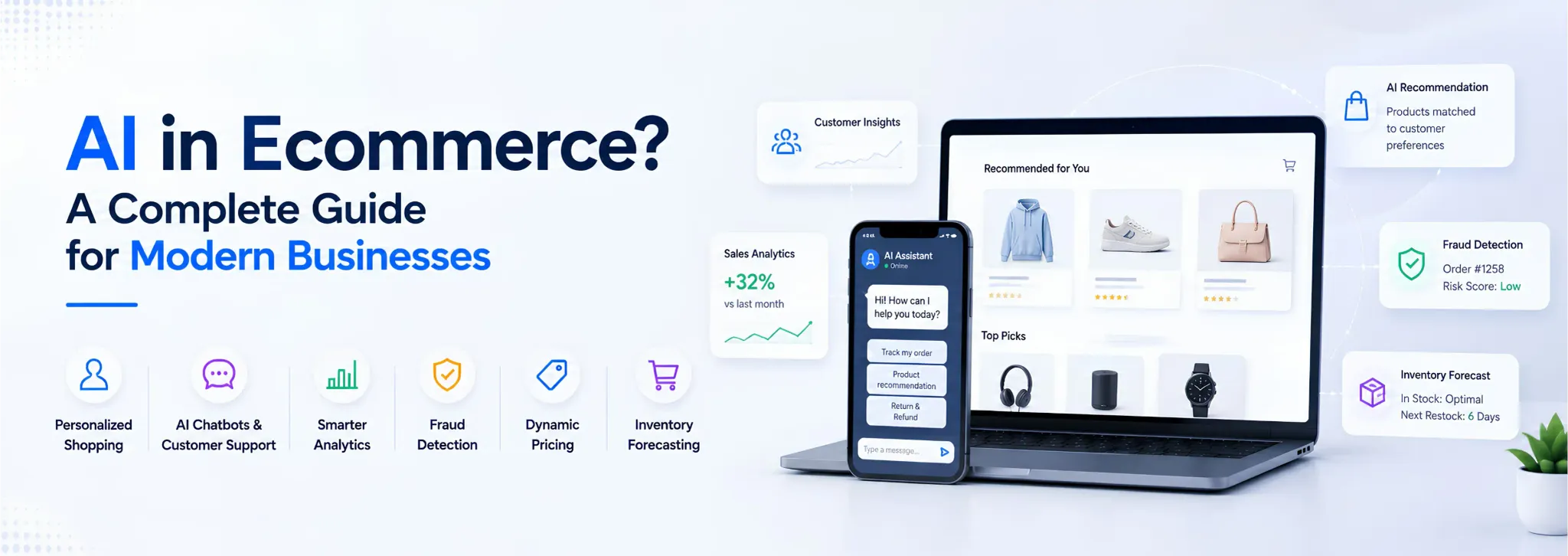
Online stores today are not just about listing products and taking payments. AI in Ecommerce is changing how businesses sell, how customers shop, and how decisions get made behind the scenes. From product recommendations to fraud detection, artificial intelligence has quietly become the engine that powers most of the online shopping experience.
In this guide, we’ll break down what AI in Ecommerce actually means, how it works, and how your business can start using it — without the technical jargon.
What Is AI in Ecommerce?
AI in Ecommerce simply means using artificial intelligence tools and technologies to run, improve, and automate different parts of an online store. Instead of a human manually sorting products, replying to every customer message, or checking every transaction for fraud, AI systems learn from data and handle these tasks automatically — often faster and more accurately than a person could.
Think of it like having a very smart assistant working in the background of your store 24/7. It watches how customers browse, what they buy, what they return, and what they ignore — then uses that information to make smarter decisions in real time. This is often referred to as AI Commerce, a broader term covering the full shift toward AI-driven buying and selling online.
Why AI in Ecommerce Matters for Modern Businesses
Ecommerce is a competitive space, and customers expect fast, personalized, and smooth shopping experiences. Businesses that use AI for Ecommerce are able to meet these expectations at scale, while businesses that don’t often fall behind on speed, relevance, and customer satisfaction.
Key Benefits of AI Commerce
| Benefit | What It Means for Your Business |
|---|---|
| Personalization | Shoppers see products relevant to them, increasing conversions |
| Automation | Repetitive tasks like replying to FAQs get handled instantly |
| Better Forecasting | Inventory and demand planning become more accurate |
| Fraud Prevention | Suspicious transactions are flagged before they cause losses |
| Improved Customer Support | AI chatbots reduce response time and support costs |
| Smarter Pricing | Prices adjust based on demand, competition, and stock levels |
Important points to remember:
- AI doesn’t replace your team — it removes repetitive work so your team can focus on strategy.
- Even small ecommerce stores can use AI tools without a large budget.
- AI works best when it has good, consistent data to learn from.
Core Applications of AI in Ecommerce
AI touches nearly every part of the online shopping journey. Here’s where it shows up most often.
1. Product Recommendations
AI studies browsing history, past purchases, and similar customer behavior to suggest products a shopper is likely to buy.
2. Customer Support Chatbots
AI-powered chatbots answer common questions, track orders, and guide customers through checkout without needing a human agent.
3. Inventory and Demand Forecasting
AI predicts which products will sell well and when, helping businesses avoid overstocking or running out of popular items.
4. Dynamic Pricing
Prices adjust automatically based on demand, competitor pricing, and seasonality.
5. Visual and Voice Search
Customers can search using images or voice commands instead of typing keywords.
6. Marketing Automation
AI segments customers and sends personalized emails, ads, or offers based on their behavior.
| Application | Business Impact |
|---|---|
| Recommendations | Higher average order value |
| Chatbots | 24/7 support at lower cost |
| Forecasting | Reduced storage and stockout costs |
| Dynamic Pricing | Improved profit margins |
| Visual/Voice Search | Better product discovery |
| Marketing Automation | Higher engagement and repeat purchases |
How To Use AI in Ecommerce
Using AI in your online store doesn’t require becoming a tech expert. Most ecommerce platforms already offer built-in AI features, so businesses just need to turn them on and let the system learn from customer data over time. A good starting point is using AI for product recommendations and customer support, since these directly improve the shopping experience without needing major changes to your website. From there, businesses can add AI for tasks like inventory forecasting, personalized email marketing, and fraud detection as they get more comfortable. The key is starting small, checking the results, and gradually expanding to more areas of the store once the AI tools show clear value.
How Does AI Personalize Shopping Experiences on Major Retail Websites?
Big retail websites use AI to track everything a shopper does — the products they view, the time spent on each page, past purchases, and even what similar customers have bought. This information is processed instantly, allowing the website to change what a customer sees in real time, such as showing different homepage products, adjusting search results, or sending personalized discount offers. The result feels like the website “knows” what the shopper wants, which is exactly the goal — using data to make shopping feel more relevant and less like browsing through a generic catalog.
Where Can I Find AI Solutions for Ecommerce Fraud Detection?
Most major ecommerce platforms, including Dhumi Commerce, provide built-in or app-based AI fraud detection capabilities that help businesses identify suspicious activities and protect online transactions. Payment systems also use AI-driven monitoring to analyze customer behavior, detect unusual patterns, and improve transaction security. For businesses looking for more advanced protection, AI-powered fraud detection solutions can be integrated to predict potential risks, flag unusual transactions, prevent suspicious orders, and reduce chargebacks.
These intelligent security capabilities are becoming an important part of Predictive Ecommerce, where businesses use data-driven insights and AI systems to anticipate threats, improve transaction safety, optimize operations, and create more reliable shopping experiences.
Challenges of Implementing AI in Ecommerce
While AI offers major advantages, it’s not always a plug-and-play solution. Businesses should be aware of a few common challenges before diving in.
Important points to consider:
- Data quality matters — AI is only as good as the data it learns from.
- Initial setup takes time — some AI tools need a learning period before results improve.
- Customer trust — transparency about data usage builds confidence with shoppers.
- Cost vs. scale — advanced AI tools may only make sense once a store reaches a certain size.
| Challenge | Simple Solution |
|---|---|
| Poor data quality | Clean and organize customer/product data regularly |
| High initial cost | Start with built-in platform AI tools before investing in custom solutions |
| Learning curve | Begin with one AI feature, then expand gradually |
| Data privacy concerns | Be transparent with customers about how their data is used |
The Future of AI for Ecommerce
AI in Ecommerce is only going to grow. Businesses are moving toward more advanced personalization, AI-generated product content, smarter voice and visual search, and even AI-powered virtual shopping assistants. As AI Commerce matures, the gap between businesses using AI and those relying on traditional methods will likely widen — making early adoption a real competitive advantage rather than just a trend to watch.
Final Thoughts
AI in Ecommerce is no longer optional for businesses that want to stay competitive. From personalized shopping experiences to smarter fraud detection and automated customer support, AI helps modern ecommerce businesses run more efficiently while giving customers a better, faster, and more relevant shopping experience. The businesses that start small, use the right tools, and build on their results over time will be the ones best positioned for long-term growth in the AI-driven future of online shopping.