


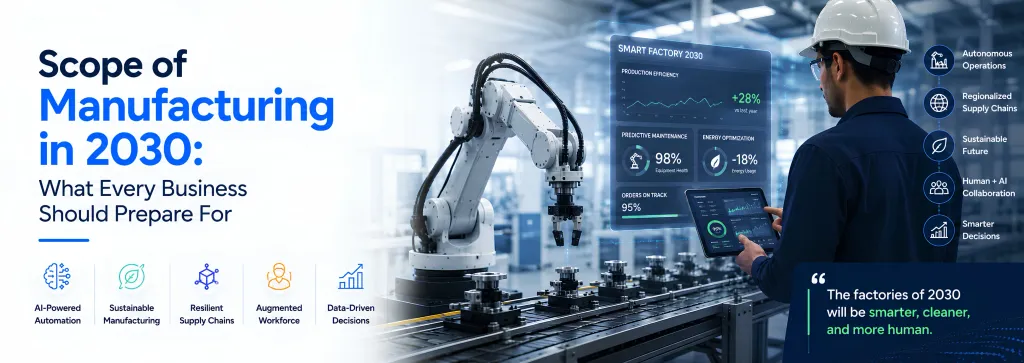
Picture a plant manager checking her phone at 6 AM. Not for emails, for a message from her factory floor. A machine flagged its own bearing wear three days before it would have failed, ordered the replacement part, and blocked the maintenance slot on the calendar. She didn’t ask for any of this. It just happened, and production never stopped. That’s the scope of smart manufacturing in practice: systems that sense, decide, and act on their own. It’s already happening in pockets across India and the world, and by 2030 it will be closer to normal than exception. The real question for any manufacturing business isn’t whether this arrives. It’s whether your manufacturing scope is wide enough to include it.
This piece walks through what manufacturing in 2030 will actually look like, based on where the trends are pointing right now, and what a business should start doing today instead of waiting for the future to show up uninvited.
What Will Manufacturing Look Like in 2030?
Manufacturing in 2030 will be defined by factories that can sense, decide, and act with far less human intervention than today, backed by AI, connected sensors, and automation that’s finally affordable for smaller operations. Large manufacturers are already piloting fully autonomous “lights-out” production lines. Reliance Industries and Larsen & Toubro have committed a massive joint investment specifically to build AI-powered, self-correcting factory floors before the decade is out. That’s the ambitious end of the spectrum. The more relevant end, for most businesses reading this, is what happens as those same capabilities trickle down into modular, subscription-priced tools that a mid-size plant can actually afford.
The shift isn’t about replacing every worker with a robot. It’s about machines handling the repetitive, error-prone, and hazardous parts of the job, while people move into roles that involve judgment, oversight, and problem-solving. Think of it less as automation and more as delegation.
The Shift From Automation to Autonomy
There’s a real difference between a machine that follows fixed instructions and one that adapts. Automation means a robot arm does the same weld every time, exactly as programmed. Autonomy means the system notices when something’s off, a part is slightly misaligned, a temperature reading drifted, and corrects course without waiting for a person to notice.
By 2030, expect more factories to run on what some call an AI orchestration layer: a central system that connects machines, sensors, and software so they can respond to each other in real time, not just to a human operator. For smaller manufacturers, full autonomy across an entire plant is still out of reach financially. But “islands of automation,” a single automated inspection station, one predictive maintenance system on your most critical machine, are a realistic starting point. You don’t need to automate everything at once to start seeing the payoff.
Sustainability and Regionalized Supply Chains
The other force reshaping manufacturing in 2030 is where things get made and how much waste that process creates. Rising freight costs, carbon regulations, and supply chain shocks are pushing companies to manufacture closer to where their customers actually are, rather than shipping everything from the cheapest possible location. Roughly 85% of manufacturers surveyed globally say they intend to regionalize production to manage these pressures.
This matters for smaller Indian manufacturers in a specific way: it’s an opening, not just a threat. As larger buyers look to diversify away from single-country supply chains, regional and mid-size manufacturers become more attractive partners, provided they can prove consistent quality and traceability. That’s where digital tools, automated compliance reporting, and real-time quality dashboards come in. They’re what let a mid-size factory prove it can meet the same standards as a much bigger one.
The Workforce Gap Nobody’s Talking About Enough
Here’s a number worth sitting with: nearly 1.9 million US manufacturing jobs are projected to go unfilled by 2030 due to a shrinking pool of skilled workers, and India faces its own version of this gap as automation adoption accelerates faster than the workforce can be trained for it. The answer manufacturers are turning to isn’t just hiring harder. It’s augmentation: cobots (collaborative robots designed to work alongside people rather than replace them), AI copilots that guide workers through complex tasks, and AR-based training that gets new hires productive in days instead of months.
For a business owner, this reframes the labor shortage conversation. The goal for manufacturing in 2030 isn’t finding more people to do the same repetitive work. It’s finding fewer people who can supervise smarter systems, and giving your current team the tools to become those people.
Data Becomes the New Raw Material
Every sensor, every machine log, every quality check generates data, and by 2030 the businesses that win won’t just be the ones with the most data. They’ll be the ones who can actually use it. IoT and edge computing are already helping manufacturers cut equipment failures and maintenance costs substantially by catching problems before they become breakdowns. But raw data sitting in a spreadsheet doesn’t do anything on its own. It needs to be connected to decisions, an alert that triggers a reorder, a dashboard that flags a bottleneck before it delays a shipment.
This is exactly where a lot of small and mid-size manufacturers get stuck. They’re collecting more data than ever, but it’s scattered across machines, paper logs, and disconnected software, with nobody able to see the full picture in one place.
Manufacturing Today vs. Manufacturing in 2030
| Manufacturing Today | Manufacturing in 2030 | |
|---|---|---|
| Maintenance | Reactive, fix it after it breaks | Predictive, flagged before failure |
| Quality control | Manual inspection, delayed defect detection | AI-powered inspection, real-time defect capture |
| Data | Siloed across machines and spreadsheets | Connected dashboards feeding live decisions |
| Supply chain | Centralized, long-distance sourcing | Regionalized, closer to demand |
| Workforce role | Manual, repetitive tasks | Oversight, system supervision, exception handling |
Widening Your Manufacturing Scope for 2030
None of this requires a factory-wide overhaul overnight, and honestly, trying to do it all at once is how most automation projects stall out. The real shift for most businesses is a mental one: widening your manufacturing scope to include things that used to feel like “someone else’s department”, data, software, workflow design, as core parts of running a factory, not side projects.
In practice, that means picking one painful, well-understood process, whether that’s quality inspection, maintenance scheduling, or procurement approvals, and automating that first. Prove it works, measure the impact, and use that as the case for the next step.
This is also where a lot of manufacturers realize they don’t need to build custom software from scratch or wait a year for an ERP rollout. Dhumi’s low-code AI platform lets manufacturing teams build the exact workflow they need, whether that’s an approval chain, a maintenance tracker, or a quality dashboard, without a development team, and adjust it as the manufacturing scope of the business grows. If quality control specifically is your bottleneck, it’s worth reading how AI-powered quality inspection is already cutting defect rates and complaint volumes for manufacturers using computer vision on the shop floor.
Frequently Asked Questions
Will small manufacturers be able to afford automation by 2030?
Yes, and this is one of the more encouraging parts of the shift. Automation costs have been dropping steadily as tools become modular and cloud-based instead of requiring a massive upfront installation. A small manufacturer today can automate a single process, like defect detection or maintenance alerts, for a fraction of what a full system would have cost a decade ago, then expand from there.
What skills will manufacturing workers need in 2030?
Workers will need less hands-on repetitive skill and more system-level understanding, knowing how to read a dashboard, respond to an automated alert, and make judgment calls that a machine can’t. Training programs are already shifting toward this, using AR and AI copilots to get people comfortable supervising automated systems rather than just running manual machinery.
Is full factory automation realistic for most businesses by 2030?
Not for most. Full lights-out automation is mostly limited to large-scale manufacturers with heavy capital to invest. For everyone else, the realistic path is targeted automation of specific bottlenecks, one process at a time, rather than trying to automate an entire plant at once.
How does sustainability factor into manufacturing in 2030?
Sustainability is becoming a business requirement, not just a compliance checkbox. Regionalized supply chains, energy-efficient production, and reduced waste are being driven by both regulation and customer expectation, and manufacturers who can prove their sustainability credentials with real data will have an edge when bidding for larger contracts.
The Bottom Line
The scope of smart manufacturing keeps widening every year, and by 2030 it will touch almost every part of how a factory runs, not just the machines on the floor. Manufacturing in 2030 won’t look like a single dramatic leap. It’ll look like a series of small, deliberate upgrades that add up: one predictive maintenance system here, one automated quality check there, one workflow that used to eat up a full day now running itself. The businesses that get there comfortably are the ones who expand their manufacturing scope early, starting with one process, not the ones waiting for the whole picture to become clear first.
If this sounds like where your shop floor is headed, Dhumi’s manufacturing workflow automation breaks down exactly where automation tends to pay off first, procurement, quality documentation, and onboarding, and how to get started without a full system overhaul.